The Most Dangerous Word in Your Holiday Shopping Bag Is 'Gift'
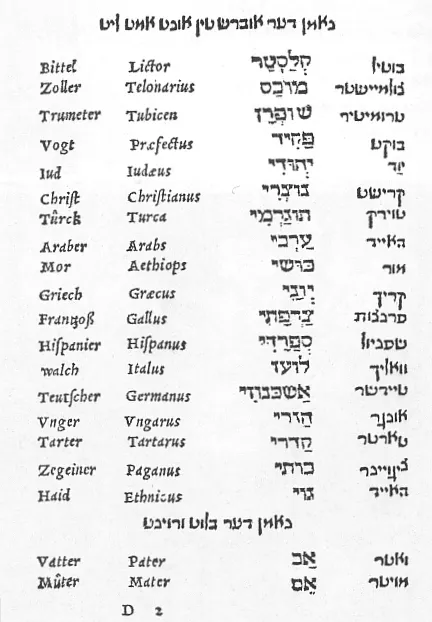
Photo: Helias Levita (Elias Levita, Elijah Levita), Public domain, via Wikimedia Commons
Picture a German exchange student wandering through a US mall in December. They see a cheerful sign reading GIFT SHOP and stop cold. To you, that sign promises tinsel, scented candles, and ceramic snowmen. To a German speaker, Gift means poison. The shop has not suddenly become a hazmat scene, but the word is doing what false friends do best: smiling warmly while stepping on your foot.
A four-letter word with two passports
English gift and German Gift are cousins. Both trace back to a Germanic root tied to giving, and English probably picked up its version from Old Norse during the Viking Age. The word settled into English so comfortably that we forget it ever had a passport. We gift presents, gift cards, and gift wrap. We talk about a gifted musician. The word is generous in every direction.
German took a different road. Modern German uses Geschenk for a present and Gabe for a gift or donation. Gift, the neuter noun, is the word for poison. Not a quaint, old-fashioned poison. Not a fairy-tale poison. The ordinary, label-on-a-bottle, call-the-doctor kind. German has giftig for poisonous and Gegengift for antidote. The word is not rare. It is household vocabulary.
That split is what makes Gift one of the most treacherous words in a bilingual shopping bag. It looks like a friend. It sounds like a friend. Then it quietly hands you a skull-and-crossbones instead of a bow.
How a present turned toxic
Nobody held a press conference when the meaning shifted. Etymologists generally trace the German sense to an older idea of a gift as something given, including a dose or a draught. A gift could be a portion, and a portion could be medicine. Medicine could be potent. Potent could be dangerous. Over time, the dangerous sense won. By the late medieval and early modern periods, German Gift had narrowed toward poison, while English kept the birthday-party meaning.
That is a tidy summary of a messy process. Semantic change rarely happens in a straight line. Words drift, narrow, widen, and get dragged around by euphemism and habit. English went shopping. German went toxicology. The family resemblance survived, but the two words stopped sharing a calendar.
This is also why Gift is such a good false friend. It is not a random coincidence, like two unrelated words that happen to look alike. It is a genuine relative that took a dark turn. That makes the confusion more interesting and, if you are writing holiday labels, more dangerous.
The false friend in the gift aisle
False friends are words that look alike across languages but mean different things. Gift is the classic example, and the holiday season is its natural habitat. Imagine an English speaker trying to be thoughtful in German and saying, Ich habe dir ein Gift gekauft. The intended message is I bought you a present. The actual message is closer to I bought you a poison. The correct word is Geschenk: Ich habe dir ein Geschenk gekauft.
The trouble multiplies in compound words. A gift card is a Geschenkkarte, not a Giftkarte. Gift wrap is Geschenkpapier. A gift set is a Geschenkset. A gift basket is a Geschenkkorb. A gift shop, in German, is more naturally a Geschenkeladen or a Souvenirladen. If you run a small business and you slap the word Gift on a product for German-speaking customers, you are not being festive. You are making a hazard label.
This is how a handmade candle ends up with a story. A crafter translates a label word by word, a relative opens the package, and suddenly the room is laughing too hard to explain the joke. The candle is fine. The word is not.
Translation apps and the 2 a.m. label
Machine translation has gotten good at context, but it still stumbles when a single word carries two radically different lives. A context-blind glossary might offer Gift for gift and call it a day. A tired human at 2 a.m. might accept that answer because it looks right. That is how false friends sneak into Etsy listings, office party invitations, and holiday cards.
The fix is not complicated. Translate the meaning, not the word. This is a gift becomes Das ist ein Geschenk. This is poison becomes Das ist Gift. Keep the two sentences far apart. If you are making a bilingual label, have a German speaker glance at it before you print 200 copies. And if you are typing Gift onto a package for a German-speaking friend, ask yourself whether you mean present or poison. The answer should change the stationery.
A mini field guide for the bilingual shopping bag
- Present: Geschenk
- Gift card: Geschenkkarte
- Gift wrap: Geschenkpapier
- Gift box: Geschenkbox
- Gift exchange: Geschenkaustausch, or Wichteln for a Secret Santa-style swap
- Poison: Gift
- Poisonous: giftig
- Antidote: Gegengift
That last cluster is the one to keep away from the ribbon drawer. German Gift is not a word you want on a tag unless the tag is attached to something that should legally require a warning.
Why the split stuck
English and German share a lot of vocabulary DNA, which is exactly why false friends are so useful. They remind us that languages are not code systems with one-to-one replacements. They are histories. Gift in English carries the sense of giving. Gift in German carries the sense of a dose that went wrong. Both meanings are old relatives. Only one of them belongs under a Christmas tree.
The holiday angle makes the etymology practical. You are not just learning a fun fact about German. You are learning why a word-for-word translation can turn a thoughtful present into a punch line. Gift is a reminder that context is not decoration. It is the whole gift.
So this holiday season, if you are shopping for German-speaking friends, write Geschenk when you mean present. Save Gift for the poison. The English word is harmless. The German word is not. That is the trick, and it is a good one.