Resolution Means 'Untie,' and That's Why Your Gym Membership Is Doomed
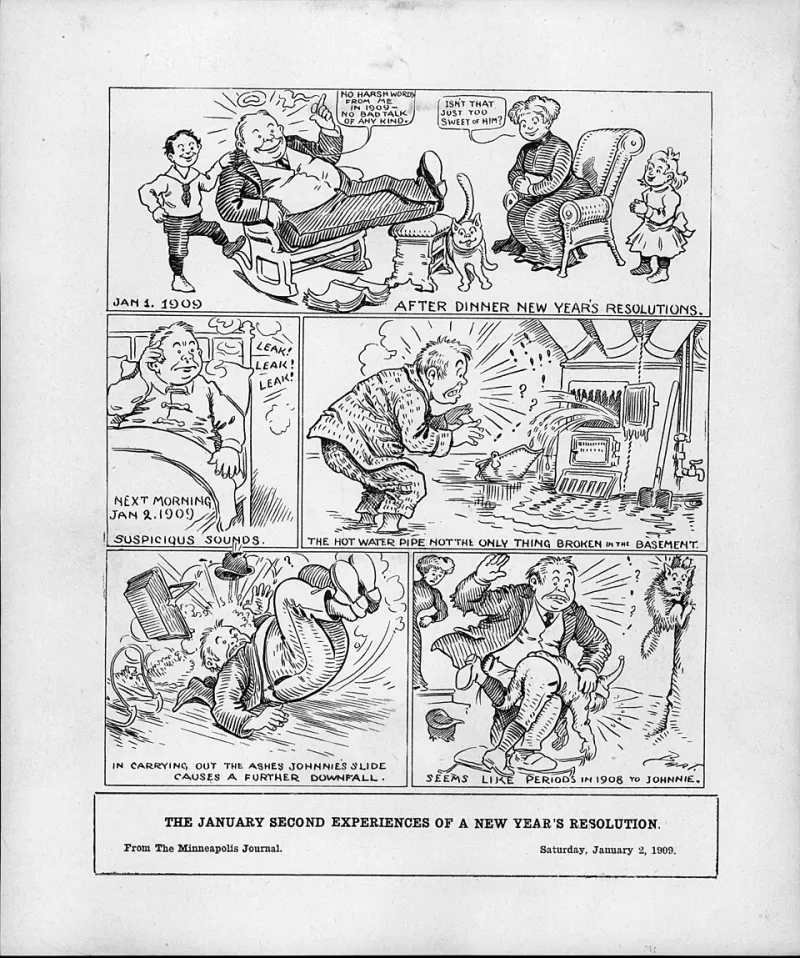
Photo: Bartholomew, Charles Lewis 'Bart', 1869-1949, Public domain, via Wikimedia Commons
January is a word graveyard. Gyms fill up. Planners get purchased. Someone in your life announces they are 'doing dry January' with the solemnity of a Supreme Court justice. And everywhere, in group chats and journal pages and corporate goal-setting decks, the same word appears: resolution.
We treat a resolution like a steel cable. It is supposed to be firm, binding, non-negotiable. But the word itself is doing something sneakier. 'Resolution' comes from the Latin 'resolvere,' which means to loosen, untie, or dissolve. That is not a steel cable. That is a knot slipping open.
This is not just a fun etymology fact. It may explain why so many New Year's resolutions collapse by the second week of February.
The Word Is Basically 'Untie Again'
Break 'resolvere' into pieces and the problem gets clearer. The 're-' means again or back. 'Solvere' means to loosen, release, or untie. The same root gives us 'dissolve,' 'solution,' 'solvent,' and 'absolve.' A solution, in the oldest sense, is what happens when something comes apart or gets worked loose. A solvent loosens a substance. Absolution is a releasing from guilt.
So a resolution is not originally a promise you clamp onto your life. It is a loosening. A breaking up. A returning to a less tangled state. In medicine, a resolution is the disappearance of inflammation. In music, a resolution is the movement from tension to rest. In chemistry, resolution is the separation of a mixture. In law, a resolution can be a formal decision, yes—but even there, the word carries the sense of a matter being settled, untangled, done.
None of this sounds like 'I will go to the gym five times a week and also learn Italian.'
How 'Loosening' Became 'Self-Improvement'
The modern self-improvement resolution is a relatively recent costume for an old word. People have made vows and oaths for as long as there have been calendars, and the New Year's resolution as a recognizable ritual took shape in the 19th century. By the 20th, it had become a full-blown American genre: lose weight, save money, quit a habit, read more books, be nicer to the group chat.
The word 'resolution' got pulled along because it already had a sense of firm determination. English developed that meaning centuries ago. But the older, looser meaning never went away. It is still in the dictionary, sitting quietly under the modern one like a trapdoor.
That double life is what makes the word so interesting. A resolution is both a decision and a dissolution. It is a thing you declare and a thing that comes apart. No wonder January feels unstable.
Why the Etymology Stings
Here is the uncomfortable part: the word's history quietly undercuts the way we use it. We ask a word that means 'loosen' to do the work of 'bind.' We ask a word about dissolving to act like glue. We take a term from medicine and music and chemistry—fields where resolution means a process reaching its natural end—and we turn it into a moral test with a deadline.
That is a lot of pressure for four syllables.
There is also a practical problem. Resolutions tend to be absolute. 'I will never eat sugar again.' 'I will run every day.' 'I will finally become the kind of person who flosses and also flosses cheerfully.' Absolutes are brittle. One missed day and the whole structure cracks. The word sounds final, so we treat the goal as final, so the first failure feels like a verdict.
A loosening, by contrast, implies adjustment. It implies that something was tangled and is being worked free. That is a much better model for behavior change.
Three Words That Might Serve You Better
If 'resolution' is the wrong tool, what is the right one? Here are three candidates, each with a different job.
Intention. An intention is a direction, not a verdict. It stretches toward something without pretending the whole year is already decided. 'My intention is to cook more at home' leaves room for a Tuesday when you order pizza and do not spiral.
Habit. A habit is a repeated action, not a dramatic vow. It is boring in the best way. You do not need to resolve to floss; you need to put the floss where you will see it. The word 'habit' asks for systems, not speeches.
Experiment. An experiment is a test, and tests are allowed to fail. 'I am experimenting with a 10 p.m. bedtime' is a very different sentence from 'I resolve to sleep eight hours every night.' One invites data. The other invites shame.
None of these words is magic. But they are better matched to how people actually change: messily, incrementally, and with occasional relapses. They do not promise that the knot will stay tied forever. They suggest that you can keep working at it.
Quiz: Resolution or Dissolution?
-
The Latin 'resolvere' means: A) to promise loudly B) to loosen or untie C) to freeze in place D) to repeat a slogan
-
Which word does NOT share the 'solvere' root? A) dissolve B) solution C) absolve D) solitude
-
In music, a resolution is: A) a note that refuses to move B) movement from tension to rest C) a drum solo D) a canceled gig
-
The modern self-improvement 'resolution' is closest to: A) a legal verdict B) a firm decision C) a chemical separation D) a medical swelling
-
Which alternative does this article suggest for a January goal? A) oath B) experiment C) ultimatum D) decree
Answers: 1-B, 2-D, 3-B, 4-B, 5-B. If you got them all, you may now gently correct people at brunch. If you did not, congratulations—you are still allowed to make a resolution about it.
A Better Vow for 2026
You do not have to abandon the word. It is a good word, and it has survived a lot of centuries. But it is worth hearing its old echo. A resolution is not a padlock. It is a loosening. It is the moment a tangled thing starts to come free.
So if you make a resolution for 2026, maybe make it a small one. Something you can untie and retie without declaring yourself a failure. The dictionary is not watching. The gym is not judging. And the word itself has been quietly telling you the truth all along: sometimes the strongest move is to loosen your grip.